



- Home
- News Room
- Patient Stories
- Finding Answers With the Support of a Team

November 24, 2025
Athletes know how important it is to work as a team. When Kate Ingram needed help identifying, treating and recovering from several medical issues preventing her from playing soccer, she sought out an elite team at the health system that was even larger than she expected.
Kate’s 18-month journey to getting back on the pitch included 3 physicians, 5 surgical procedures, 2 athletic trainers, a physical therapist, dietitian and sport psychologist.
“Kate used every resource as a health system that we have for our female athletes,” says Lisa Vopat, MD, a sports medicine physician and director of the female athlete program. “Kate is a story of resiliency. There was a period of significant uncertainty for her and what this meant for her athletic goals and her future in addition to dealing with the daily pain. She showed that you don’t have to do it alone. You can lean on all your resources, whether it be psychology or nutrition or multiple providers or your parents. You don’t have to do it by yourself.”
The best part is I feel completely pain-free in my legs. I didn't know if that was going to happen. I'm so grateful for Dr. (Bryan) Vopat and everybody who has helped me get to where I am today." Kate Ingram
Kate Ingram:
I just always loved having a ball at my feet, at my hands, doing anything active. My parents could not keep me still whenever I was little, so I always had to be doing something.
Jessica Lovell:
Kate Ingram grew up surrounded with competition.
Kate Ingram:
I grew up with two older brothers, so that was always kind of a competitive nature with them. I was always kind of competing with them. I wanted to do exactly what they did.
Jessica Lovell:
As she grew, so did that passion for all sports. Now a junior in high school, soccer gets all of Kate's focus.
Kate Ingram:
It was fast paced, and I just kind of fell in love with it.
Jessica Lovell:
She's a star goalie for sporting Blue Valley Club soccer team, but it was about the time she made varsity as a freshman at Blue Valley West High School that Kate noticed something was off.
Kate Ingram:
I felt all of like the cramping in my calves and kind of the feeling of shin splints in my lower legs first, but I just didn't really think anything of it. Kind of, I was like, I was training so many days a week that I was like, okay, this has to be normal.
Jessica Lovell:
Kate pushed through, but her symptoms got worse. She was referred to The University of Kansas Health System’s sports medicine team. Testing showed Kate had 3 things happening in each leg. One, running caused her leg muscles to expand so much her connective tissue under the skin tightened, causing an aching and sometimes sharp pain. A condition called exertional compartment syndrome, common in runners. Two, her back leg pain was a result of her calf pressing against a vein - a rare but serious condition called popliteal artery entrapment syndrome. And, three, Kate had pinched nerves in both of her legs. Kate wouldn't just sit out a game or 2. She was out nearly 18 months.
Kate Ingram:
Just kind of watching everybody get to do what they love and just kind of having to sit back and kind of that feeling that you're falling behind a little bit was definitely hard.
Jessica Lovell:
Kate saw orthopedic surgeon doctor Bryan Vopat. She had several procedures, including a fasciotomy and a neurolysis to release nerve pressure in both legs. Later, she was in the care of Dr. Lisa Vopat, director of the female athlete program that focuses exclusively on the unique needs of women in sports.
Kate Ingram:
I think as an athlete, you kind of just think of the physical side of it, and so being able to hit it from like all different aspects, I think is super, super cool and like, it just it taught me more that it's a whole body thing. It's not just physically but mentally too.
Jessica Lovell:
After months of strict physical therapy, rest and recovery, Kate is back to the sport she loves and shares this advice for others facing a similar fate.
Kate Ingram:
I know it doesn't seem like it whenever you're in the valley but put your head down, grind and you will make it out. There will be a victory on the other side.
Jessica Lovell:
As for Kate, today, she's keeping her eye on the ball and an almost certain D1 college scholarship with her name on it.
The gray area
Kate’s story started many years before she was referred to the health system. As a competitive soccer goalkeeper, Kate says she noticed a tight feeling in her calves for years. But the pain escalated to cramping and started to include shin splints. In early 2024, she made the varsity team at Blue Valley West as a freshman, but her excitement was tempered by the increasing levels of fatigue she was feeling in her legs.
Her high school coach started to notice Kate’s ankle would give out when she was planting her foot, so he sent her to see Tyler Sleeper, West’s athletic trainer and a member of the health system. He in turn referred Kate to sports medicine physician JP Darche, MD. Dr. Darche suspected peroneal nerve entrapment and sent Kate for testing, which would take about 2 weeks. He told her to stop playing in the meantime to avoid additional injury.
“When he said I couldn't play, I was devastated,” says Kate. “I felt like I had worked so hard to get to that position and next thing I know it's stripped away from me. But I was also very hopeful because it was a really quick turnaround.”
Orthopedic surgeon Bryan Vopat, MD, performed a nerve release and then Kate took 4 weeks to recover. It was fast enough that she could rejoin her high school season.
“As soon as I stepped back on the field, I could feel that something is still not right,” says Kate.
She explained the symptoms to Dr. Bryan Vopat who identified 2 possible causes – chronic exertional compartment syndrome and popliteal artery entrapment syndrome. An angiogram showed complete occlusion of Kate’s popliteal artery. The team decided to move forward with treatment of the popliteal artery in her right leg, so Kate went back into surgery.
“I'm so grateful (Dr. Bryan Vopat) decided to also test for popliteal entrapment. I think we might have done the compartment syndrome surgery first, and I wouldn't have gotten full relief,” says Kate.
In early 2025 , Kate was busy rehabbing her legs. She worked with Cameron Zimmerman, a physical therapist at the health system, and Krisha Crane, a trainer at the Sports Medicine and Performance Center. But things still weren’t quite right, so Kate was referred to Dr. Lisa Vopat to test for compartment syndrome again.
“Compartment syndrome is progressive, meaning that you have a build-up of the pressure where the fascia doesn’t stretch around the muscle compartments. And it progresses and worsens over time, where you become less and less tolerant to exercise and more and more symptomatic,” says Dr. Lisa Vopat. "So, when I saw her, her pressures were not diagnostic for release. They were middle of the road, a little gray.”
Dr. Lisa Vopat noted that Kate had lost weight to a degree that she could be underfueling and affecting her ability to recover, so she referred her to the female athlete program’s dietitian.
“A lot of athletes have a mindset that when they're recovering from surgery and in rehab, I must not need to eat as much because I'm not actively in sport. But what I find is that the energy demands of healing from an injury and rehab are just as high as being fully active in sport, if not higher. Our fueling has to remain the same or if not more intentional than it was before,” says Dr. Lisa Vopat.
But even with improved nutrition, Kate’s legs didn’t get better. Both Drs. Vopat conferred with Kate and her family and decided it was time to try the compartment release surgery. She had the compartments released on both legs and had the popliteal artery entrapment surgery on her left leg.
“At the end of the day, she needed all the things for these 3 diagnoses. She had multiple conditions that required surgery that are all connected to each other. But I would say it is rare to have all of them that needed to be treated surgically together,” says Dr. Lisa Vopat. “These are conditions that occur in athletes, and we don't really understand how or why a lot of times that this develops. Like I said, because these diagnoses and the testing are not black and white, they’re very gray, we had to support her from every aspect to try and figure out how to get her better, and it wasn't simple. It's not slam dunk like you tear your ACL, your MRI shows your ACL is torn, you get surgery. In Kate's case, every time I met with her, it was a constant risk-benefit analysis of each treatment.”
Keeping a positive mindset
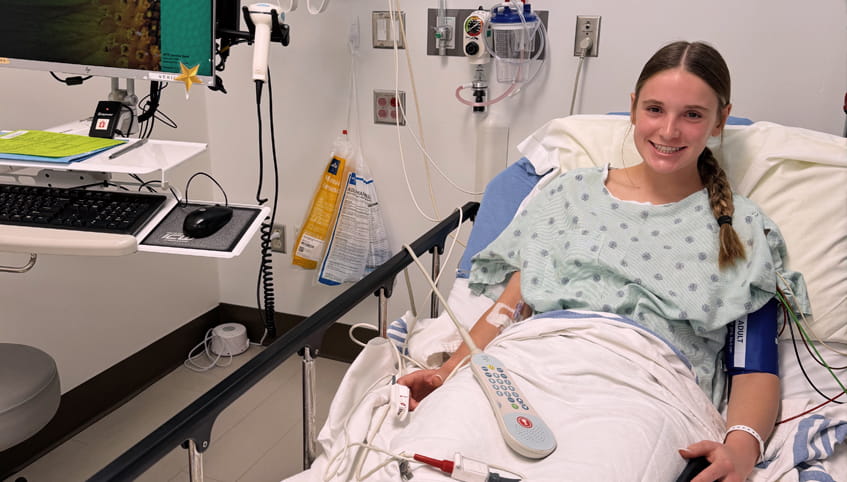
Dealing with all the uncertainty and ongoing treatment decisions was a challenge for Kate from the very beginning of this journey. Dr. Bryan Vopat referred her to sport psychologist Brett Woods, MD, a few months after her first diagnosis to help with that. But Kate wasn’t sure she needed any help.
“As an athlete, I've always put on that face like, ‘I don't need help. I'm fine.’ My mom kind of pushed me to go once,” says Kate. “The first time I met with (Dr. Woods), I realized I was wrong. He's awesome. I'm grateful that I got pushed a little bit into doing it.”
Kate also got mental support from her rehab team.
“My PT, Cameron Zimmerman, was the greatest light for me through this all. Also, Krisha at the sports performance center. They both were always there for me not just physically but mentally through it all,” says Kate. “Having them around me as my support system meant the world.”
Zimmerman agreed that it was a holistic process.
“It's not just about restoring their movement and getting them back to sport,” he says. “It's partnering with them to rebuild their belief in themselves, and a big part of that is the relationship piece, just making sure that you're building those relationships so there is a level of trust as you progress through that rehab.”
And Zimmerman stressed that the complexity of Kate’s situation required a lot of relationships with and collaboration from the whole team at the health system and female athlete program.
“From Dr. Lisa Vopat to Dr. Woods to one of the athletic trainers at the sports performance center, there was definitely a ton of collaboration trying to make sure we're hitting every point we can and addressing all these things throughout the process,” Zimmerman says.

Back in the game
After 18 months on the sideline, Kate was cleared to return to playing soccer with her club team in September.
“I am feeling so, so good. Having that final appointment of being completely cleared was the biggest sigh of relief. I was crying tears of joy. It's been such a long journey,” says Kate. “The best part is I feel completely pain-free in my legs. I didn't know if that was going to happen. I'm so grateful for Dr. (Bryan) Vopat and everybody who has helped me get to where I am today.”
Zimmerman has continued to work with Kate and said once she returned to playing, she truly lit up with joy. He credits her work for this successful outcome.
“I think her attitude and dedication to training and doing what she needed to do, even when it wasn't easy, was the biggest thing. She showed up every day, even when she was having pain or symptoms weren't going away, just to kind of rebuild,” he says.
Kate is looking ahead to playing a full season of high school soccer and hoping to be recruited to play in college. She has great advice for other athletes facing uncertainty and setbacks.
“I would say it's a long journey and a hard journey. Truly you find pieces of yourself you didn't know you had. Celebrate the small wins,” says Kate. “Perspective is a huge thing. You can look at it from a negative outlook or a positive lens. It's really hard when you're going through it. It feels like a really big valley. But there's brighter days ahead.”
Kate Ingram: My name is Kate and I’m a part of the female athlete program at The University of Kansas Health System. I got the opportunity to go out to the training center on Wednesday. I also got to meet Lorena, which was super cool. So we got to talk and got to bond over both being goalkeepers, and I got her jersey too. She’s awesome, she’s fearless in the box, she’s back there supporting everybody. She’s just kind of the glue to the team.
Kate: So it all kind of started in April of 2024. I started to experience a lot of different symptoms in my calves, in my shins, so I went in and saw some doctors at The University of Kansas Health System. I was diagnosed with chronic exertional compartment syndrome, popliteal artery entrapment syndrome and peroneal nerve entrapment in both legs.
Kate: Going through 5 surgeries in 18 months at such a young age was definitely difficult for sure. I had played soccer all my life and kind of in an instant it was taken away from me. It’s changed my perspective a lot. It changed my love for the game, and it really, just shapes you just to have such gratitude for not only what your body is able to do for you but just the simple things in life.
Kate: I’ve been going through this journey for the past 18, 19 months and so this kind of feels like the finish line.
Kate: Congrats on your shutouts! That’s so exciting.
Lorena: Thank you, I am so happy for the new record. Hey, I have one present for you, wait here.
Kate: Okay, thank you. Oh my gosh!
Kate’s mom: Oh my gosh, Kate!
Kate: Thank you, this means the world.
Kate: The game was awesome, I had a super fun experience. Thank you so much to The University of Kansas Health System and the KC Current for having me.